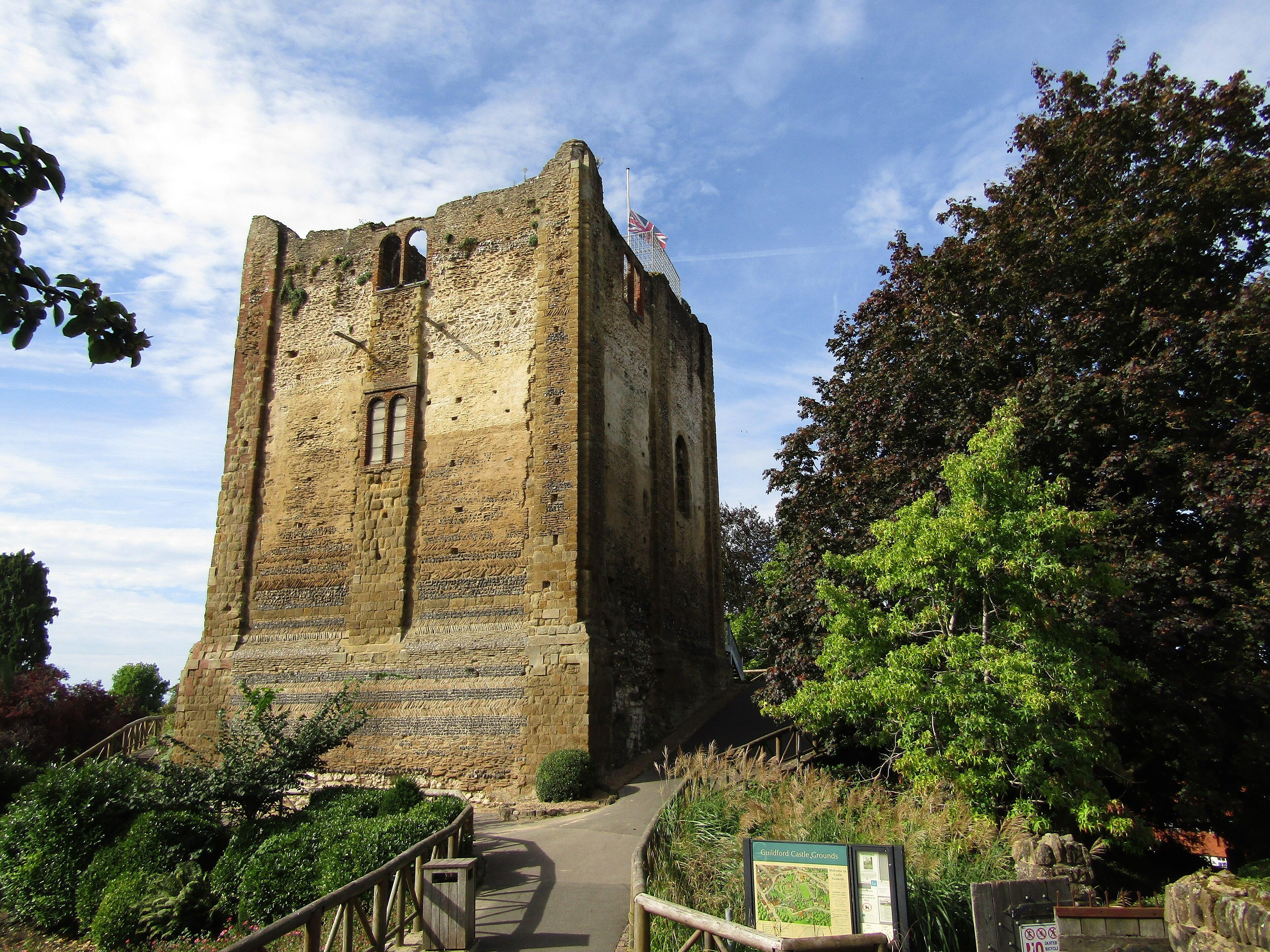
Guildford Castle is best thought of as a park with a ruin in it. The grounds on Castle Street, Guildford (GU1 3UW), are free and open daily from 8am to dusk, all year. The keep is the seasonal extra, which matters if you are visiting in the colder months.
When the keep is open
The council gives the keep's 2026 season as 4 April to 3 October, with a special Halloween reopening in October. In mid-November, expect to see it from outside. In season it opens Wednesday to Saturday, 12 noon to 4.30pm, with last admission at 4pm. Tickets are £5 for adults, £2.50 for children and £12 for a family of two adults and up to two children. Under-5s are free. Check the council's opening times page before you set out.
Inside, there is a model of the castle as it stood around 1300, along with interpretation panels. Climbing the Great Tower gives a 360-degree view over Guildford and the countryside, according to Visit Surrey.
A short history of the keep
The castle is thought to have been built by William the Conqueror, or one of his barons, soon after 1066. It began as a motte-and-bailey castle, at a time when Guildford was Surrey's most important town. The stone keep dates to about 1150. It is built of chalk, and Historic England notes medieval graffiti on its walls. The entrance is on the first floor, a defensive choice.
This was the only royal castle in Surrey, and the sheriff's headquarters. The keep also served as the county gaol for Surrey and Sussex, with prison use beginning by the end of the 12th century. Henry III, who reigned from 1216 to 1272, turned it into one of the most luxurious royal palaces in England. A fire between 1250 and 1253 destroyed much of his work, and rebuilding followed. After his death in 1272 the buildings fell into ruin and were later abandoned. The castle was later used as a royal palace, a prison and a private residence, before Guildford Corporation bought it and the grounds in 1885. The council's history page has the outline.
The gardens
The grounds opened as public gardens in 1888, marking Queen Victoria's Golden Jubilee. They are Green Flag winning and described as Guildford's premier town-centre park. You will find a Victorian bandstand and passageways, a pond, a 17th-century bowls green, the town war memorial and an Alice Garden. Spring and summer bedding displays change each year, and there is open-air theatre in summer. Visit Surrey and the Surrey Hills site list the main features. Dogs are welcome on leads, according to one third-party listing.
This is a place for a slow loop at any time of year, and the grounds suit a short break from the shops as much as a longer visit.
The Alice connection
The bronze statue Alice Through the Looking Glass is by the sculptor Jeanne Argent and dates from 1990. It shows Alice halfway through a looking glass, on a square plinth among formal flowerbeds near the bowling green and the keep. The link to Lewis Carroll, Charles Dodgson, is real: he spent a lot of time in Guildford with his sisters. Their Georgian house, The Chestnuts, is on Castle Hill and backs onto the grounds.
Guildford Museum has a Lewis Carroll display, and a Gertrude Jekyll display too.
The museum and the High Street below
Guildford Museum sits at the edge of the castle grounds, in a Grade II listed building on Quarry Street. Quarry Street is a narrow road of pre-1900 cottages just off the pedestrianised High Street. The museum has a Scullery play area for children. Check its hours before you go.
Guildford House Gallery is at 155 High Street (GU1 3AJ), and entry is free. It was built in 1660 as a merchant's house for John Childs, a lawyer and later three-time mayor. Look for the carved staircase and moulded plaster ceilings. It holds the world's largest public collection of pastel portraits by the Guildford-born artist John Russell RA (1745 to 1806). There is also a craft shop, a tourist information centre and a cafe. Gallery hours vary between listings, so confirm them first.
The High Street itself is paved with granite setts and runs down to the River Wey, which makes the walk from castle to river an easy one.
Who it suits
Families will like the grounds and the Scullery, anyone interested in history will want the keep in season, and anyone with an hour to spare can combine the gardens, the Alice statue and the gallery in a single walk.