Surrey's literary map is best read on foot. The railways of the nineteenth century brought writers and artists to the Surrey Hills, as Surrey Life notes, and several of them left something you can still stand beside. Some places welcome visitors. Others are private homes or a working school, and are best seen from the road. Here is how to tell which is which.
Box Hill, Dorking: the Emma picnic
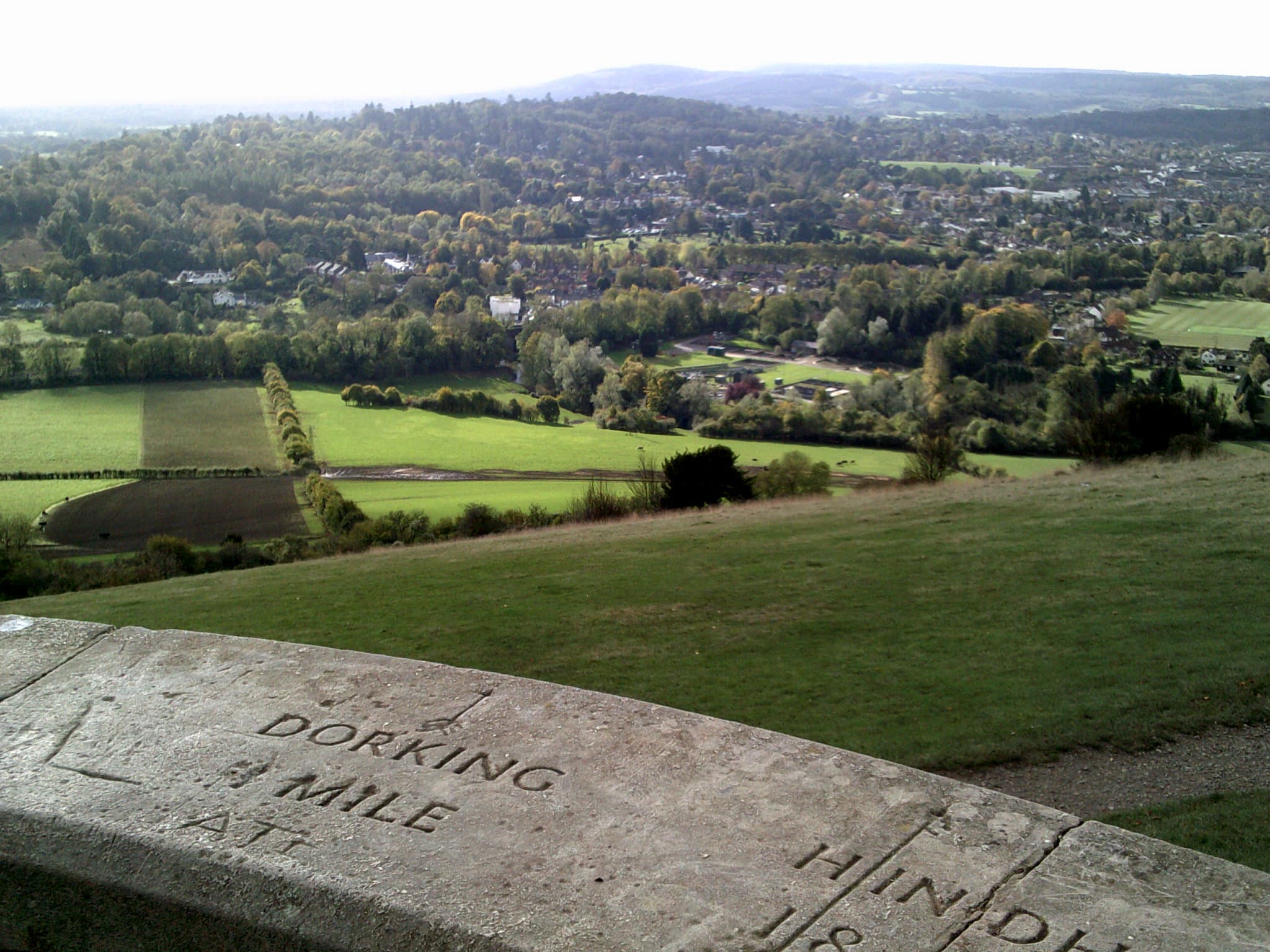
Box Hill is National Trust woodland and chalk downland, and part of the Surrey Hills National Landscape. Visit Surrey says the famous picnic scene in Jane Austen's Emma takes place here. Country Life quotes Austen on the party's arrival, when everybody "had a burst of admiration", before the outing slides into "a want of spirits".
Salomons Viewpoint commemorates Leopold Salomons, the London financier who gave Box Hill to the National Trust in 1914 to protect it from development. From it, the Trust points out Norbury Park, once Salomons' home, Juniper Hall, once home to Thomas Broadwood of the piano family, and Cherkley Court, once Lord Beaverbrook's.
The National Trust's Juniper Top circular walk starts about a mile from Dorking station and half a mile from Boxhill station, and takes in a mile of the North Downs Way from Stepping Stones to South Scarp. By bus, get off at North Downs Way southbound or Westhumble Street northbound for the Stepping Stones, or at Zig Zag Road and follow the signposted bridleway to the summit.
When to go: the countryside is open dawn to dusk. The National Trust runs an annual Box Hill Regency Picnic recreating the Emma scene, usually in early July. Check its events page for the next date.
Refreshments: the café is open daily from 10am, with barista coffees, cakes and bakes, and hot and light lunches. Hot food runs from 11am to 2.30pm. The servery sells breakfast baps (8 to 11.30am), pastries and pies, with an ice-cream kiosk next door. Bring your own cup for 25p off. There is also a second-hand bookshop. Hours change with the season, so check the National Trust page before you set off.
Rules: no overnight parking or camping, and no fires or barbecues.
Country Life adds that Keats finished Endymion while staying nearby, and lists J. M. Barrie, John Logie Baird and Conan Doyle among Box Hill's literary and inventive visitors. Agatha Christie, it notes, famously disappeared from Newlands Corner.
Flint Cottage and the Burford Bridge Hotel
George Meredith lived at Flint Cottage, on the slopes of Box Hill at the bottom of the Zig Zag Road, from 1868 until his death in 1909. According to Dorking Museum, he first came to Mickleham on a walking trip and in 1864 married a local woman, Marie Vulliamy, at St Michael's, Mickleham. He wrote in a two-room chalet in the garden.
The guest list was remarkable: Thomas Hardy, Swinburne, R. L. Stevenson, Oscar Wilde, G. B. Shaw, George Gissing, J. M. Barrie and H. G. Wells. When the cottage was full, guests stayed at the Burford Bridge hotel, which hosted a dinner for Meredith in 1895 attended by 40 leading writers. Meredith was refused burial at Westminster Abbey because of his religious unorthodoxy and is buried in Dorking Cemetery.
Flint Cottage appears to be a private home, so admire the setting from the lane rather than expecting to go in.
Burford Bridge Hotel stands on Old London Road, Mickleham, at the foot of Box Hill beside the River Mole. It is Grade II listed and now trades as a Mercure hotel. Keats stayed here, then the Fox and Hounds, while finishing Endymion, according to Keats Locations. It is worth a look as a literary stop on the way down from the hill.
Dorking Museum, 62 West Street
For the fuller story, Dorking Museum and Heritage Centre at 62 West Street, Dorking, is independent, volunteer-run and free to enter. It has accessible pages on both Meredith and E. M. Forster. It opens Thursday 1pm to 4pm, and Friday and Saturday 10am to 4pm. The telephone number is 01306 876591.
Undershaw, Hindhead: Conan Doyle's Surrey home
Arthur Conan Doyle lived at Undershaw from 1897 to 1907, hoping the air would help his wife Louisa, known as Touie, who had tuberculosis. She died in 1906. The house was built between 1895 and 1897 to a design by Joseph Henry Ball, with Doyle involved in the layout, and is Grade II listed, according to Historic England. It was here that he wrote The Hound of the Baskervilles and resurrected Sherlock Holmes. Country Life notes the novel first appeared in 1901 as a serial in The Strand Magazine. Surrey Life says it has been suggested that the Dartmoor settings drew on local heathland, though that remains a theory.
Bram Stoker visited and was thrilled by the view down the Nutcombe Valley towards the South Downs, though Surrey Life says trees and scrub have since closed off the views.
Undershaw is now a school, opened as the senior school of Stepping Stones School for children and young adults with special needs after a two-year restoration and extension. It is owned by the David Forbes-Nixon Charitable Foundation, and a Haslemere Society blue plaque was unveiled at the opening. This is a working school and not a visitor attraction, so look from outside, and keep an eye out for Heritage Open Days in September, which have offered public tours before.
Hindhead Commons and the Devil's Punch Bowl
Close by, at London Road, Hindhead, the National Trust's Hindhead Commons and the Devil's Punch Bowl is an Area of Outstanding Natural Beauty with walks including the Gibbet Cross and Sailor's Stroll, Exmoor ponies and a café serving light lunches and bakes. The Trust acquired the Punch Bowl and Hindhead Common in 1906, one of its earliest open-space purchases. William Cobbett was less charmed, calling the summit "the most villainous spot that God ever made" in Rural Rides. Hindhead stands at 894ft.
Abinger Hammer: E. M. Forster
Abinger Hammer sits on the A25 in the Vale of Holmesdale, halfway between Dorking and Guildford, with a shop, a pub and a green. Forster's aunt Laura Mary Forster lived at West Hackhurst. He visited as a boy, inherited the house after her death and lived there with his mother from 1924 to 1946. Exploring Surrey's Past says his architect father designed the house and that Forster left in September 1946 when the landlord refused to renew the lease.
Dorking Museum says neighbours supplied material for his observations of Edwardian class. He wrote two pageants in response to threats to his community, collaborating with Vaughan Williams, and published the essay collection Abinger Harvest in 1936. His friends included Max Beerbohm at Abinger and Marie Stopes at Norbury Park. West Hackhurst is private, so this one is for a walk through the village.
Guildford: Lewis Carroll
Lewis Carroll, the Reverend Charles Dodgson, died in Guildford on 14 January 1898 and is buried at the Mount Cemetery. Guildford Borough Council's trail takes in St Mary's Church, where he preached, Guildford Museum with its Carroll memorabilia, the Alice statue in the Castle Grounds, and a statue of Alice and her sister at Millmead by the river. The Chestnuts, where his sisters lived and where he died, is private. Guildford Town Guides run a Lewis Carroll walk in summer. Check Guildford Museum's hours before you go.
Planning a literary weekend
Start with Box Hill and a picnic, walk down to Burford Bridge and Flint Cottage, then spend a Saturday morning at Dorking Museum. Keep Hindhead and Guildford for a second day. The Surrey Hills Society also leads a walk on Guildford borough's writers as part of Guildford Walkfest, tied to the Guildford Book Festival in October, so check dates for the year.