Runnymede is one of the few places in Surrey where a visit feels like standing inside a history lesson without anyone insisting on it. The National Trust describes it as the birthplace of Magna Carta, with history, art and nature on the banks of the Thames. The meadow lies in the Egham and Englefield Green area, in the borough of Runnymede. The National Trust's postal address uses a Berkshire postcode (Windsor Road, near Old Windsor, SL4 2JL), which is only a quirk of the postal system. Entry to the site is free.
What happened here
On 15 June 1215, King John met the barons at Runnymede and put his seal to Magna Carta. The National Trust notes that “sealed” is more accurate than “signed”. The name is believed to go back to Saxon times, and Visit Thames suggests it comes from “runieg”, a regular meeting, and “mead”, a meadow.
The meadows reached the National Trust through Lady Fairhaven, who bought them and gave them to the Trust. She commissioned Sir Edwin Lutyens to design the Fairhaven Memorial Lodges and kiosks at either end of the site, in memory of her husband, Sir Urban Broughton MP. The red-brick and Portland stone kiosks mark the entrances, and the white lodges stand at the Old Windsor end. North Lodge houses the National Trust estate office. South Lodge holds the tea-room.
The Magna Carta Memorial
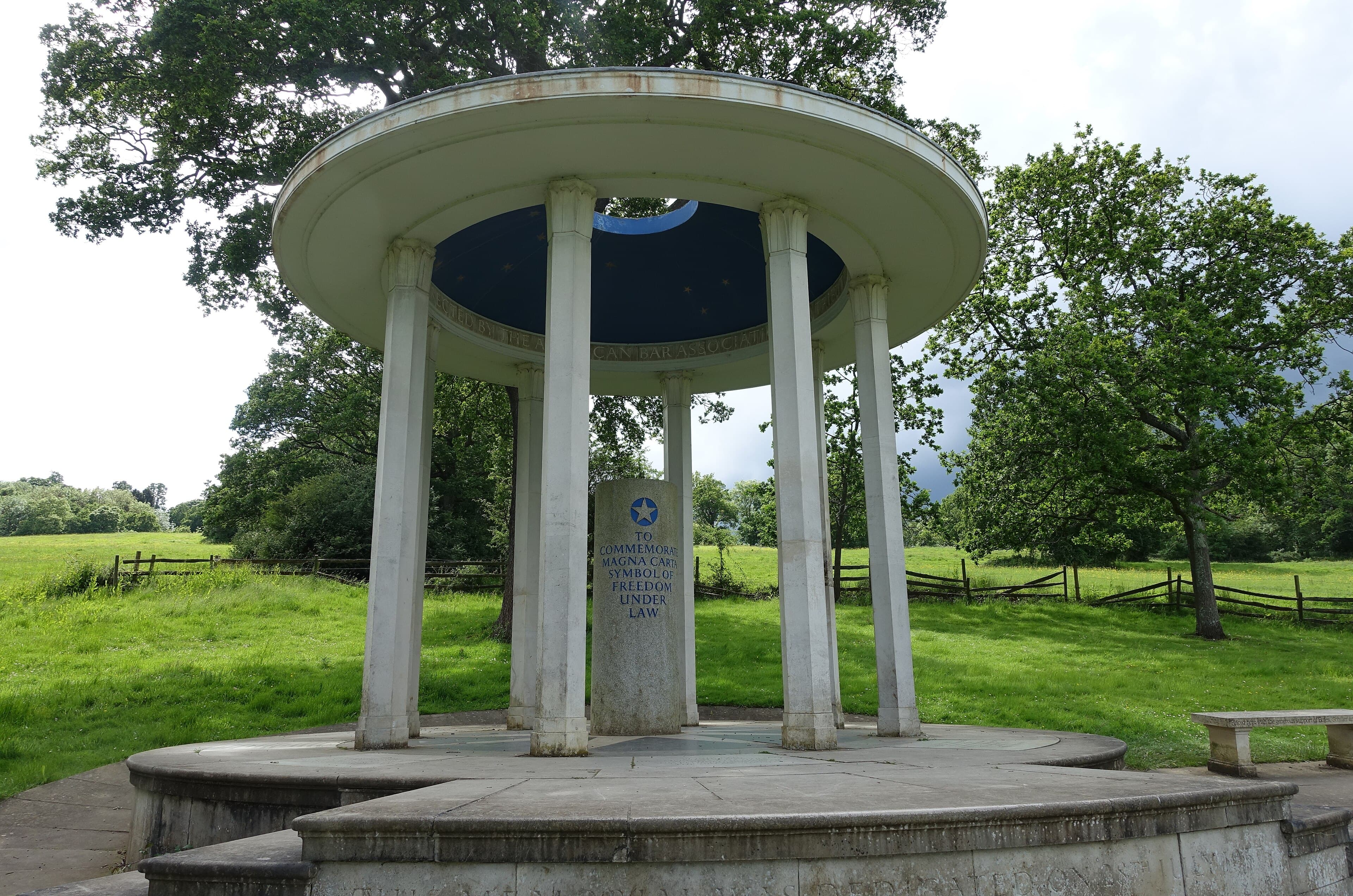
The domed memorial with seven pillars was designed by Sir Edward Maufe and erected in 1957 by the American Bar Association, in appreciation of Magna Carta's part in founding the rule of law. It is a calm, formal structure set in open grass, and a good place to begin.
Writ in Water
At the far end of the field is Writ in Water, the permanent artwork by Mark Wallinger, a Turner Prize winner, with Studio Octopi. It was commissioned by the National Trust with the arts producers Situations and opened to the public on Saturday 16 June 2018.
A wide circular skylight opens above a pool of shot-blasted stainless steel. Clause 39 of Magna Carta is inscribed on the inner side, reversed and inverted, so the water reflects the words and you read them as you walk round. The internal area is 180 square metres. The title echoes the inscription on Keats's gravestone. Wallinger has said the UK has no written constitution, and that what seems like a birthright has to be learned over and over. It is worth allowing time here rather than passing through.
The Kennedy Memorial
A short walk up the hill from the meadow leads to the memorial to John F. Kennedy, designed by Sir Geoffrey Jellicoe. It is a seven-tonne block of Portland stone, inscribed with words from Kennedy's 1961 inaugural address. Queen Elizabeth II opened it in 1965. The acre of ground was given to the American people in perpetuity, and the inscription says it was given by the people of Britain. The National Trust maintains it for the Kennedy Memorial Trust, which also funds scholarships to Harvard and MIT. You do not need a passport, and there is no charge.
The route has granite steps that can be slippery when wet, so wear shoes with a decent grip.
The Air Forces Memorial on Cooper's Hill
On the crest of Cooper's Hill, overlooking the Thames and Runnymede, stands the Air Forces Memorial. It names more than 20,000 air force men and women of the Second World War who have no known grave, lost on operations from the UK and from bases in North and Western Europe. Queen Elizabeth II unveiled it on 17 October 1953. Sir Edward Maufe designed it, with sculpture by Vernon Hill, engraved glass and painted ceilings by John Hutton, and a poem by Paul H. Scott.
A tower rises from the north end, described by the Commonwealth War Graves Commission as evocative of an airfield control tower. From the top there are views toward Windsor Castle, Heathrow and London. Three stone figures on the tower represent Justice, Victory and Courage. The memorial is closed on Christmas Day and New Year's Day. Check the Commonwealth War Graves Commission website for daily opening hours before you set out.
The walk
Visit Thames describes a four-mile Cooper's Hill circular walk taking in the Magna Carta, Air Forces and Kennedy memorials, plus Langham Ponds. The Woodland Trust describes Cooper's Hill Woods as 87 acres of broad-leaved wood, with ancient oaks, bluebells, noctule bats and green woodpeckers.
Where to start: either at the National Trust car parks on the A308, or at the Cooper's Hill Lane car park near Englefield Green, which the Woodland Trust says has free parking and toilets.
Underfoot: the water meadows can have standing water. AllTrails advises good boots, and wellingtons in wetter months.
The view: a steep climb up Cooper's Hill gives a viewing point over boats on the Thames and Magna Carta Island, with the Ankerwycke Yew visible across the river.
Afterwards: there are pubs and cafes in Englefield Green.
Ankerwycke, across the river, has the remains of a Benedictine priory and the oldest tree in the National Trust's care, the Ankerwycke Yew, which the Trust believes to be at least 2,000 years old.
Tea and a sit down
The Magna Carta Tea-rooms are in South Lodge, one of Lutyens's lodges. The National Trust says they are open daily, serving sandwiches, pasties, sausage rolls, scones and cakes, with hot and cold drinks, indoor and outdoor seating and highchairs. A small secondhand bookshop is inside. Scones, cake or a pasty suit a picnic table outside. Dine-in service ends 30 minutes before closing, while takeaway runs until closing. Well-behaved dogs on a short lead are welcome inside. There are picnic tables by the tea-room and by North Lodge across the road, and toilets, including an accessible one, at the rear of the tea-room.
Practicalities
Getting there: Runnymede is on the A308, with the nearest motorway access at M25 Junction 13.
Parking: car parks sit on either side of the A308. The Memorials car park is open all year but has limited spaces. The Riverside car park is large and open April to September. Parking is free for National Trust members, who must register, and for Blue Badge holders. Others pay by machine or JustPark. Check the National Trust page or the machine for the current tariff.
Hours: the countryside is open dawn to dusk. Tea-room and car park times vary by season, so check the National Trust page before you go.
Dogs: welcome in the countryside. Keep them on a short lead around the memorials and under close control elsewhere.
Time: allow one to two hours for the meadow and memorials, or half a day with the full walk.
Details are on the National Trust Runnymede and Ankerwycke page. For the walk, see the Woodland Trust and Commonwealth War Graves Commission guides.